Well I obviously haven't posted in some time. Hunting for olelo no`eau online and community events is actually harder than researching the plants, but in any case I haven't much time these days to do either of them. So for now we're officially on hiatus (unless another member feels like picking it up). In addition, I'm not 100% sure where the club's going, and if it does evaporate, I'll be moving to another site at the end of the semester. Same routine though.
I've also almost got enough gift cards saved to get an olelo no`eau book from Barnes and Nobles, so hopefully that'll allow me to pick up again soon.
In any case, happy readings people!

Sunday, October 7, 2012

Sunday, September 16, 2012
Issue 18: Lei Material of Ni`ihau, Momi, Laiki, Kahelelani
Organism of the Week! - Pupu o Ni`ihau: Momi, Laiki, and Kahelelani
I can't find the latin names of these species :(
These shells are found on the beaches of Ni`ihau and used to make lei. They are usually about a quarter of an inch in size and vary in color as you can see. What species are they from? A snail perhaps? Or some ocean phenomena? I don't know and google isn't very forthcoming. Enjoy photos of the shells anyways, and let me know what you think! Which is your favorite?
By Sabrina Robello
Sourced: Mostly here, photos from google
** This blog will be operating in this abridged format until I figure out law school. That means more pictures and no olelo no`eau/community events section for now. I intend to reincorporate the olelo no`eau section once I get around to buying Mary Kawena Pukui's collection of them, but its not quite a priority for me at the moment.
I can't find the latin names of these species :(
 |
| Dark colored shells are called momi kahakaha ikaika (powerful) and the light ones are ahiehie |
By Sabrina Robello
 |
| Laiki shells |
 |
| Kahelelani shells, which come in a broad range of colors |
** This blog will be operating in this abridged format until I figure out law school. That means more pictures and no olelo no`eau/community events section for now. I intend to reincorporate the olelo no`eau section once I get around to buying Mary Kawena Pukui's collection of them, but its not quite a priority for me at the moment.
Monday, September 3, 2012
Issue 17: Flower of Kaho`olawe, Hinahina
Release 17 - abridged. I have been a bit busy and have exhausted the internet's supply of non-romantic olelo no`eau. And the UH doesn't have as much relevant events as I'd hope at this point in the year.
Organism of the week! Hinahina, heliotropium anomalum
 The one week I take a break and I get more views than usual. *Sigh*, sorry to disappoint.
Anyways, this week's belated plant is the hinahina, also known as nohonohopu`uone, pohinahina, and hinahina ku kahakai. Perhaps some knowledgeable soul will translate these other names for us, as I'm lacking in that area.
This plant is a shrub that typically doesn't grow much higher than two feet, but grows as far across as two to five feet.
The plant is long-lived according to the internet - it lives longer than five years and requires a drier climate. It flowers year round and is presently used for landscaping purposes. And since it requires very little water, it's actually pretty ideal for those who live on Oahu as a landscaping plant - very low maintenance.
The leaves are covered in tiny, thin hairs that give the leaves a silvery appearance as you can see here. This was selected as Kaho`olawe's lei material perhaps because the island is so bare and harsh...and because this plant seems durable enough to grow on it.
-Sabrina Robello
Sourced: Here mostly
Community Events!
Kako`o `Oiwi - Sat, Sept. 8, 8:30am-12pm; 46-403 Kamehameha Highway Kāneʻohe HI 96744
Another lo`i workday! I know you guys love it, check it out.
Organism of the week! Hinahina, heliotropium anomalum
 The one week I take a break and I get more views than usual. *Sigh*, sorry to disappoint.
 Anyways, this week's belated plant is the hinahina, also known as nohonohopu`uone, pohinahina, and hinahina ku kahakai. Perhaps some knowledgeable soul will translate these other names for us, as I'm lacking in that area.
This plant is a shrub that typically doesn't grow much higher than two feet, but grows as far across as two to five feet.
The plant is long-lived according to the internet - it lives longer than five years and requires a drier climate. It flowers year round and is presently used for landscaping purposes. And since it requires very little water, it's actually pretty ideal for those who live on Oahu as a landscaping plant - very low maintenance.
The leaves are covered in tiny, thin hairs that give the leaves a silvery appearance as you can see here. This was selected as Kaho`olawe's lei material perhaps because the island is so bare and harsh...and because this plant seems durable enough to grow on it.
-Sabrina Robello
Sourced: Here mostly
Community Events!
Kako`o `Oiwi - Sat, Sept. 8, 8:30am-12pm; 46-403 Kamehameha Highway Kāneʻohe HI 96744
Another lo`i workday! I know you guys love it, check it out.
Sunday, August 19, 2012
Issue 16: Flower of Lana`i, Kauna`oa
Ho`ola `i na manu i ke aheahe.
The birds poise quietly in the gentle breeze.
(Said of those at peace with the world)
Organism of the Week! Kauna`oa Cuscuta Sandwichiana
 This lei material is more of a vine as you can see here - an air vine described as the native dodder (if that means anything to botanically inclined readers). The yellowish flowers of this plant grows in tiny clusters around the stem and is only a sixteenth of an inch in size. Given the delicate appearance of this plant, I assumed correctly that it is difficult to find these days.
The kauna`oa grows best in coastal areas with sandy soil, at sea-level for the most part. Materials I'm looking at says you won't find any above 975ft elevation. Also, the plant grows on other plants - "parasitizing" according to the internets.
 The part of the plant that is used in lei is the yellowy-orange tendrils that you can see above. These are taken and twined together to make a lei, like the one here. I believe the thread leis sold these days are supposed to be imitating the look of this lei now that I see it.
Apparently there were some medicinal uses for the plant as well - mixed together with some other plants and ingested will induce vomiting (used specifically for emptying the tummy of icky phlegm during cold season) or can be used in a concoction to assist women with childbirth. Fun facts, I know :)
By Sabrina Robello
Sourced: Here and here
Community Events!
Green Drinks - Every Tuesday, 5:30-8pm, Fresh Cafe
This ongoing event is for those who want to network with like-minded people as well as enjoy some farm-fresh foods. And drinks I suppose. More about it here.
Ecolounge - Every Third Thursday, 6-9pm, Indigo (1121 Nuuanu Ave)
This is described as a spot to network again with like-minded folk. Caters more to business types, but active environmentalists might be interested as well.
The birds poise quietly in the gentle breeze.
(Said of those at peace with the world)
Organism of the Week! Kauna`oa Cuscuta Sandwichiana

The kauna`oa grows best in coastal areas with sandy soil, at sea-level for the most part. Materials I'm looking at says you won't find any above 975ft elevation. Also, the plant grows on other plants - "parasitizing" according to the internets.
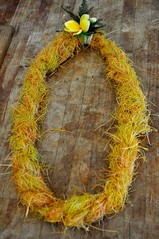 The part of the plant that is used in lei is the yellowy-orange tendrils that you can see above. These are taken and twined together to make a lei, like the one here. I believe the thread leis sold these days are supposed to be imitating the look of this lei now that I see it.
 Apparently there were some medicinal uses for the plant as well - mixed together with some other plants and ingested will induce vomiting (used specifically for emptying the tummy of icky phlegm during cold season) or can be used in a concoction to assist women with childbirth. Fun facts, I know :)
By Sabrina Robello
Sourced: Here and here
Community Events!
Green Drinks - Every Tuesday, 5:30-8pm, Fresh Cafe
This ongoing event is for those who want to network with like-minded people as well as enjoy some farm-fresh foods. And drinks I suppose. More about it here.
Ecolounge - Every Third Thursday, 6-9pm, Indigo (1121 Nuuanu Ave)
This is described as a spot to network again with like-minded folk. Caters more to business types, but active environmentalists might be interested as well.
Sunday, August 12, 2012
Issue 15: Flower of Kauai, Mokihana Berry
I ka nana no a`ike.
By observing, one will learn.
Organism of the Week! Mokihana Berry, Rutaceae Melicope Anisata
 This particular organism is obviously not a flower. Apparently it was decided each island should have its own specific lei material of which to be proud of. It just so happens many leis are made of flowers and I suppose the title was shortened to flower instead of lei material.
This plant is a native citrus tree goes by some other names locals may be more familiar with - mokehana, alani, or alani kuahiwi. The berry smells of anise (for the chefs among my few readers) and must be strung within a few hours of picking, and the scent of this berry and the plants twigs used to be a favored scent among ancient Hawaiians.
The plant this berry grows on is a shrub that grows to be between 2-8 meters tall with thick leaves. The branches can be somewhat droopy giving it a vine-like appearance. And the plant grows well in wet forests at a range of elevations - from 1200-4000 ft, and is native only to Kauai, although may be found on other islands these days. The twigs and leaves when dried can retain their anise-like scent for quite awhile and used to be placed in the folds of kapa to lend their scent to the material. Finally, the plant was indeed primarily used for its lei-making properties.
By Sabrina Robello
Sourced: Here
Community Events!
Acoustic Monitoring of Near-Shore Ecosystems - Thurs, Aug 16, 6:30pm - 7:30pm, Hanauma Bay Nature Preserve Theater
A UH Zoology grad student will be speaking at Hanauma Bay, which I presume is free (except parking I mean). For more information contact this fellow (carrier@hawaii.edu) and enjoy.
Message in the Waves - Thurs. Aug 16, 6pm-8pm, Kailua Sailboards & Kayaks Eco Lounge
This is a film screening is a free event that focuses on upcycling and the hazards of wastefulness.
Heʻeia Stream Restoration Work Day - Sat, Aug 18, 8am-11am, 46-403 Haʻikū Rd, Kāneʻohe
Volunteer opportunity! Work out the stress of returning to class with some productive manual labor. Good for you and the environment!
By observing, one will learn.
Organism of the Week! Mokihana Berry, Rutaceae Melicope Anisata

This plant is a native citrus tree goes by some other names locals may be more familiar with - mokehana, alani, or alani kuahiwi. The berry smells of anise (for the chefs among my few readers) and must be strung within a few hours of picking, and the scent of this berry and the plants twigs used to be a favored scent among ancient Hawaiians.
 |
| Mokihana berries in action. |
By Sabrina Robello
Sourced: Here
Community Events!
Acoustic Monitoring of Near-Shore Ecosystems - Thurs, Aug 16, 6:30pm - 7:30pm, Hanauma Bay Nature Preserve Theater
A UH Zoology grad student will be speaking at Hanauma Bay, which I presume is free (except parking I mean). For more information contact this fellow (carrier@hawaii.edu) and enjoy.
Message in the Waves - Thurs. Aug 16, 6pm-8pm, Kailua Sailboards & Kayaks Eco Lounge
This is a film screening is a free event that focuses on upcycling and the hazards of wastefulness.
Heʻeia Stream Restoration Work Day - Sat, Aug 18, 8am-11am, 46-403 Haʻikū Rd, Kāneʻohe
Volunteer opportunity! Work out the stress of returning to class with some productive manual labor. Good for you and the environment!
Tuesday, August 7, 2012
Issue 14: Flower of Molokai, Kukui Blossom
`A`ohe pau ka `ike i ka halau ho`okahi.
All knowledge is not learned from one school.
Organism of the Week! kukui blossom, Aleurites Moluccana
 This flower is the blossom on the kukui tree or candlenut tree. The flower is tiny as you can see here, with tiny white petals. The fruit of this blossom yields the ever useful kukui nut, the uses of which I will go into in a later post.
However, the flower and fruit of this plant are used to make lovely leis in this case, and fortunately grow easily in the wild here in Hawaii as the plant requires lots of tropical weather. Incidentally, the kukui is not native to Hawaii but was later brought here by early settlers, which I suppose I must have learned at some point in my education, but was forgotten. Considering how much the kukui tree is a symbol of Hawaii, it's interesting to learn that it was brought from an even more ancient culture here with settlers.
The flower and fruit are not the only well known things about this plant. The tree itself is a symbol of our state, the state tree.
-Sabrina Robello
Sourced: Here and here
Community Events:
Climate Change and Philanthropy: Wed, Aug 8, 12pm-1pm, Hamilton Library Classroom 3F
This free event will feature the European Climate Foundation and will discuss climate change and the ways the ECF are striving to stop it.
Ke Kani o Ke Kai: Thurs, Aug 9, 7pm - 9pm, 2777 Kalakaua Avenue
Wish I'd posted this up earlier! Tickets are no longer available for Jake Shimabukuro's concert, so for those determined to attend, admittance without pre-ordered tickets will be on a first come first serve basis. Doors open at 5:30 for the determined!
All knowledge is not learned from one school.
Organism of the Week! kukui blossom, Aleurites Moluccana

However, the flower and fruit of this plant are used to make lovely leis in this case, and fortunately grow easily in the wild here in Hawaii as the plant requires lots of tropical weather. Incidentally, the kukui is not native to Hawaii but was later brought here by early settlers, which I suppose I must have learned at some point in my education, but was forgotten. Considering how much the kukui tree is a symbol of Hawaii, it's interesting to learn that it was brought from an even more ancient culture here with settlers.
The flower and fruit are not the only well known things about this plant. The tree itself is a symbol of our state, the state tree.
-Sabrina Robello
Sourced: Here and here
Community Events:
Climate Change and Philanthropy: Wed, Aug 8, 12pm-1pm, Hamilton Library Classroom 3F
This free event will feature the European Climate Foundation and will discuss climate change and the ways the ECF are striving to stop it.
Ke Kani o Ke Kai: Thurs, Aug 9, 7pm - 9pm, 2777 Kalakaua Avenue
Wish I'd posted this up earlier! Tickets are no longer available for Jake Shimabukuro's concert, so for those determined to attend, admittance without pre-ordered tickets will be on a first come first serve basis. Doors open at 5:30 for the determined!
Sunday, July 29, 2012
Issue 13: Flower of Maui, Pink Lokelani
E kolo ana no ke ewe i ke ewe.
The root creeps toward other roots.
Kin seek out and love each other.
Organism of the week! Pink Lokelani - Rosa damascena
 This deciduous shrub can grow up to 7ish ft tall and has bristles and prickles to protect itself. It is not native to Hawaii, nor can it be found in the wild anymore, but is most likely from the Middle East. This flower is very fragrant and clearly lovely to look upon, and I believe is used in lei.
It's believed that this flower was brought to Hawaii in the 1800s, possibly by English crews and whatnot, vaunted for its beauty and fragrance. Since it doesn't seem to thrive in the wild these days, it's impact on our native ecosystem is hopefully minimal.
The internet seems to have a limited supply of information on this flower though - if you happen to have anything to add, please do share in the comments below!
-Sabrina Robello
Sourced: Here and here
PS: I'm currently in the process of moving into my apartment, so the next few blogs may be similarly brief, but fear not I'll do my best to devote time to posting some interesting bits here anyways!
The root creeps toward other roots.
Kin seek out and love each other.
Organism of the week! Pink Lokelani - Rosa damascena
 This deciduous shrub can grow up to 7ish ft tall and has bristles and prickles to protect itself. It is not native to Hawaii, nor can it be found in the wild anymore, but is most likely from the Middle East. This flower is very fragrant and clearly lovely to look upon, and I believe is used in lei.
It's believed that this flower was brought to Hawaii in the 1800s, possibly by English crews and whatnot, vaunted for its beauty and fragrance. Since it doesn't seem to thrive in the wild these days, it's impact on our native ecosystem is hopefully minimal.
The internet seems to have a limited supply of information on this flower though - if you happen to have anything to add, please do share in the comments below!
-Sabrina Robello
Sourced: Here and here
PS: I'm currently in the process of moving into my apartment, so the next few blogs may be similarly brief, but fear not I'll do my best to devote time to posting some interesting bits here anyways!
Subscribe to:
Posts (Atom)