Keke`e ka waha, ua nahu i ka makani.
His mouth is wry after biting the wind.
Said of one who has found that what he said of others is true of himself.
Organism of the week! Ipu awaawa, lagenaria siceraria
This plant is related to the pumpkin and other squash plants. It grows as a vine in hot, sunny areas and can apparently live off relatively little water. The internet says this iconic plant actually prefers a dry, hot climate. The plant can grow over other plants as well, with stems reaching 10 - 20 ft in length. The ipu awaawa grows best in these hot climates at an elevation below 1500 ft, and is supposed to be fairly easy to grow. I understand that there are other issues related to the growing of ipu though, such as diseases it may catch that can wither the plant, so it sounds like climate and environment are less of an issue than that.
The ipu awaawa was a bitter plant and was used medicinally and as containers. Supposedly Hawaiians used the ipu more extensively than any other Pacific Islander people, but I'm not 100% on that.
Then again, ipus were also used as musical instruments. Pear shaped ipu could be turned into a whistle, ipu hokiokio, or rattles, `uli`uli, or ipu hula which beat out the familiar u-te-te rhythm.
By Sabrina Robello
Sourced: Here and here.
Community Events!
Lei Workshop for the Keiki - 9:30 - 10:30, 10:30-11:30 - Lyon Arboretum
This event requires you to preregister so check the UH Manoa campus events calendar to do so! Five dollars will pay for your whole family to sit down and learn to string leis and learn the traditional Hawaiian method of lei-making.
21st Annual Conservation Conference Registration - July 16-18 - Hawaii Convention Center
This program runs through a weekend in the summer and before you lose interest, students can go for the low, low price of $50! This program will run a variety of lectures focused on improving Hawaii, and given that the normal price is approximately seven times that, my few readers should definitely take advantage of this opportunity! Check out hawaiiconservation.org to register early.
Tuesday, February 12, 2013
Monday, February 4, 2013
Issue 20: Pia
Ihea `oe i ka wa* a ka ua e loku ana?
Where were you when the rain was pouring?
A reference to fair-weather friends; those who disappear when times are difficult.
Organism of the Week! Pia, Tacca leontopetaloides
Celebrate, my vast readership! For today we cover pia, the starchy root that allowed Hawaiians to make the tasty dessert haupia!
Pia is one of the plants ancient Polynesians brought with them in their canoes when they first voyaged across the Pacific to Hawaii. Pia is the Polynesian arrowroot and is bitter and starchy when it's not in the delicious form of haupia.
The plant grows to be 1 to 3 feet tall and grows in wet woods at low altitudes. It was so useful that it was widely cultivated alongside taro. The leaves also die off in the winter and the root will remain dormant until spring to sprout up again.
Hawaiians processed the root by grating or pounding it in a bowl and let it sit with water. The starch would settle to the bottom and the bitterness would be released into the water. The water would be poured out daily and replaced with fresh water while the starch sat at the bottom. This would draw out all the bitterness, apparently. Once it was gone, the starch would be spread on flat rocks to dry, then scraped off and ground into a powder. If the starch was not needed immediately it was formed into small cakes and stored.
Is that not amazing? I think it's pretty amazing. I love learning about how ancient peoples did things and this is right up my alley. Also, I mentioned that this root is how haupia was made to Ryan and he popped right up to make some. Haupia moves people :)
Anyways. The starch would be mixed with coconut milk then steamed or baked to make haupia. The starch could be used the way starch is in many households, to stiffen fabrics. But it also had medicinal properties - the starch could be mixed with water and alae to cure dysentery and diarrhea.
By Sabrina Robello
Sourced: Here mostly, an excellent site for Hawaiian canoe plant information
Community Events
Green Drinks - Tues. Feb. 5, 5:30pm-7:30pm, P.F. Chang's
Networking with conservation-minded business peoples.
Kako`o `Oiwi - Sat, Feb. 9, 8:30am-12pm; 46-403 Kamehameha Highway Kāneʻohe HI 96744
Lo`i work day!
* I've decided to tackle the issue of kahako's with a strikethrough. If someone knows how to do this on a blog, please let me know.
Where were you when the rain was pouring?
A reference to fair-weather friends; those who disappear when times are difficult.
Organism of the Week! Pia, Tacca leontopetaloides
| This is not Pia. The internet has a dearth of pictures of the plant, but this is a similar species I believe. |
Pia is one of the plants ancient Polynesians brought with them in their canoes when they first voyaged across the Pacific to Hawaii. Pia is the Polynesian arrowroot and is bitter and starchy when it's not in the delicious form of haupia.
The plant grows to be 1 to 3 feet tall and grows in wet woods at low altitudes. It was so useful that it was widely cultivated alongside taro. The leaves also die off in the winter and the root will remain dormant until spring to sprout up again.
Hawaiians processed the root by grating or pounding it in a bowl and let it sit with water. The starch would settle to the bottom and the bitterness would be released into the water. The water would be poured out daily and replaced with fresh water while the starch sat at the bottom. This would draw out all the bitterness, apparently. Once it was gone, the starch would be spread on flat rocks to dry, then scraped off and ground into a powder. If the starch was not needed immediately it was formed into small cakes and stored.
Is that not amazing? I think it's pretty amazing. I love learning about how ancient peoples did things and this is right up my alley. Also, I mentioned that this root is how haupia was made to Ryan and he popped right up to make some. Haupia moves people :)
Anyways. The starch would be mixed with coconut milk then steamed or baked to make haupia. The starch could be used the way starch is in many households, to stiffen fabrics. But it also had medicinal properties - the starch could be mixed with water and alae to cure dysentery and diarrhea.
By Sabrina Robello
Sourced: Here mostly, an excellent site for Hawaiian canoe plant information
Community Events
Green Drinks - Tues. Feb. 5, 5:30pm-7:30pm, P.F. Chang's
Networking with conservation-minded business peoples.
Kako`o `Oiwi - Sat, Feb. 9, 8:30am-12pm; 46-403 Kamehameha Highway Kāneʻohe HI 96744
Lo`i work day!
* I've decided to tackle the issue of kahako's with a strikethrough. If someone knows how to do this on a blog, please let me know.
Tuesday, January 29, 2013
Issue 19: `Olena
Ka manu ka`upu halo `ale o ka moana.
The ka`upu, the bird that observes the ocean.
Said of a careful observer.
After a semester-long hiatus, I'm back and re-energized! Sort of. But I do have a new book that I'm excited to use! Mary Kawena Pukui's compilation of olelo no`eau!
Organism of the Week: `Olena, curcuma domestica
This is the `olena plant, a member of the ginger family and commonly known as turmeric around the world. This is a plant brought over by ancient Polynesians when they voyaged to Hawai`i. The plant is small and produces leafy clusters as you can see here instead of a stem exactly.
`Olena grows in moist, forested valleys up to altitudes of 3000ft, but is now rarely found in nature these days.
Hawaiians used `olena medicinally - the juice from the roots would ease earaches and clear sinuses when mixed with water. When lightly cooked and eaten, `olena was useful for colds, asthma, consumption and other illnesses of the like. It can be taken as a diuretic or applied topically will clear up acne or stop bleeding. It also serves as an antibacterial.
`Olena was also used for ceremonial purposes, like purification of mana or to bless a new home.
Source: Here.
Sunday, October 7, 2012
On Hiatus...
Well I obviously haven't posted in some time. Hunting for olelo no`eau online and community events is actually harder than researching the plants, but in any case I haven't much time these days to do either of them. So for now we're officially on hiatus (unless another member feels like picking it up). In addition, I'm not 100% sure where the club's going, and if it does evaporate, I'll be moving to another site at the end of the semester. Same routine though.
I've also almost got enough gift cards saved to get an olelo no`eau book from Barnes and Nobles, so hopefully that'll allow me to pick up again soon.
In any case, happy readings people!
I've also almost got enough gift cards saved to get an olelo no`eau book from Barnes and Nobles, so hopefully that'll allow me to pick up again soon.
In any case, happy readings people!
Sunday, September 16, 2012
Issue 18: Lei Material of Ni`ihau, Momi, Laiki, Kahelelani
Organism of the Week! - Pupu o Ni`ihau: Momi, Laiki, and Kahelelani
I can't find the latin names of these species :(
These shells are found on the beaches of Ni`ihau and used to make lei. They are usually about a quarter of an inch in size and vary in color as you can see. What species are they from? A snail perhaps? Or some ocean phenomena? I don't know and google isn't very forthcoming. Enjoy photos of the shells anyways, and let me know what you think! Which is your favorite?
By Sabrina Robello
Sourced: Mostly here, photos from google
** This blog will be operating in this abridged format until I figure out law school. That means more pictures and no olelo no`eau/community events section for now. I intend to reincorporate the olelo no`eau section once I get around to buying Mary Kawena Pukui's collection of them, but its not quite a priority for me at the moment.
I can't find the latin names of these species :(
| Dark colored shells are called momi kahakaha ikaika (powerful) and the light ones are ahiehie |
By Sabrina Robello
| Laiki shells |
| Kahelelani shells, which come in a broad range of colors |
** This blog will be operating in this abridged format until I figure out law school. That means more pictures and no olelo no`eau/community events section for now. I intend to reincorporate the olelo no`eau section once I get around to buying Mary Kawena Pukui's collection of them, but its not quite a priority for me at the moment.
Monday, September 3, 2012
Issue 17: Flower of Kaho`olawe, Hinahina
Release 17 - abridged. I have been a bit busy and have exhausted the internet's supply of non-romantic olelo no`eau. And the UH doesn't have as much relevant events as I'd hope at this point in the year.
Organism of the week! Hinahina, heliotropium anomalum
The one week I take a break and I get more views than usual. *Sigh*, sorry to disappoint.
Anyways, this week's belated plant is the hinahina, also known as nohonohopu`uone, pohinahina, and hinahina ku kahakai. Perhaps some knowledgeable soul will translate these other names for us, as I'm lacking in that area.
This plant is a shrub that typically doesn't grow much higher than two feet, but grows as far across as two to five feet.
The plant is long-lived according to the internet - it lives longer than five years and requires a drier climate. It flowers year round and is presently used for landscaping purposes. And since it requires very little water, it's actually pretty ideal for those who live on Oahu as a landscaping plant - very low maintenance.
The leaves are covered in tiny, thin hairs that give the leaves a silvery appearance as you can see here. This was selected as Kaho`olawe's lei material perhaps because the island is so bare and harsh...and because this plant seems durable enough to grow on it.
-Sabrina Robello
Sourced: Here mostly
Community Events!
Kako`o `Oiwi - Sat, Sept. 8, 8:30am-12pm; 46-403 Kamehameha Highway Kāneʻohe HI 96744
Another lo`i workday! I know you guys love it, check it out.
Organism of the week! Hinahina, heliotropium anomalum
Anyways, this week's belated plant is the hinahina, also known as nohonohopu`uone, pohinahina, and hinahina ku kahakai. Perhaps some knowledgeable soul will translate these other names for us, as I'm lacking in that area.
This plant is a shrub that typically doesn't grow much higher than two feet, but grows as far across as two to five feet.
The plant is long-lived according to the internet - it lives longer than five years and requires a drier climate. It flowers year round and is presently used for landscaping purposes. And since it requires very little water, it's actually pretty ideal for those who live on Oahu as a landscaping plant - very low maintenance.
The leaves are covered in tiny, thin hairs that give the leaves a silvery appearance as you can see here. This was selected as Kaho`olawe's lei material perhaps because the island is so bare and harsh...and because this plant seems durable enough to grow on it.
-Sabrina Robello
Sourced: Here mostly
Community Events!
Kako`o `Oiwi - Sat, Sept. 8, 8:30am-12pm; 46-403 Kamehameha Highway Kāneʻohe HI 96744
Another lo`i workday! I know you guys love it, check it out.
Sunday, August 19, 2012
Issue 16: Flower of Lana`i, Kauna`oa
Ho`ola `i na manu i ke aheahe.
The birds poise quietly in the gentle breeze.
(Said of those at peace with the world)
Organism of the Week! Kauna`oa Cuscuta Sandwichiana
This lei material is more of a vine as you can see here - an air vine described as the native dodder (if that means anything to botanically inclined readers). The yellowish flowers of this plant grows in tiny clusters around the stem and is only a sixteenth of an inch in size. Given the delicate appearance of this plant, I assumed correctly that it is difficult to find these days.
The kauna`oa grows best in coastal areas with sandy soil, at sea-level for the most part. Materials I'm looking at says you won't find any above 975ft elevation. Also, the plant grows on other plants - "parasitizing" according to the internets.
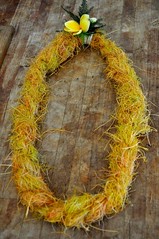
The part of the plant that is used in lei is the yellowy-orange tendrils that you can see above. These are taken and twined together to make a lei, like the one here. I believe the thread leis sold these days are supposed to be imitating the look of this lei now that I see it.
Apparently there were some medicinal uses for the plant as well - mixed together with some other plants and ingested will induce vomiting (used specifically for emptying the tummy of icky phlegm during cold season) or can be used in a concoction to assist women with childbirth. Fun facts, I know :)
By Sabrina Robello
Sourced: Here and here
Community Events!
Green Drinks - Every Tuesday, 5:30-8pm, Fresh Cafe
This ongoing event is for those who want to network with like-minded people as well as enjoy some farm-fresh foods. And drinks I suppose. More about it here.
Ecolounge - Every Third Thursday, 6-9pm, Indigo (1121 Nuuanu Ave)
This is described as a spot to network again with like-minded folk. Caters more to business types, but active environmentalists might be interested as well.
The birds poise quietly in the gentle breeze.
(Said of those at peace with the world)
Organism of the Week! Kauna`oa Cuscuta Sandwichiana
This lei material is more of a vine as you can see here - an air vine described as the native dodder (if that means anything to botanically inclined readers). The yellowish flowers of this plant grows in tiny clusters around the stem and is only a sixteenth of an inch in size. Given the delicate appearance of this plant, I assumed correctly that it is difficult to find these days.
The kauna`oa grows best in coastal areas with sandy soil, at sea-level for the most part. Materials I'm looking at says you won't find any above 975ft elevation. Also, the plant grows on other plants - "parasitizing" according to the internets.
Apparently there were some medicinal uses for the plant as well - mixed together with some other plants and ingested will induce vomiting (used specifically for emptying the tummy of icky phlegm during cold season) or can be used in a concoction to assist women with childbirth. Fun facts, I know :)
By Sabrina Robello
Sourced: Here and here
Community Events!
Green Drinks - Every Tuesday, 5:30-8pm, Fresh Cafe
This ongoing event is for those who want to network with like-minded people as well as enjoy some farm-fresh foods. And drinks I suppose. More about it here.
Ecolounge - Every Third Thursday, 6-9pm, Indigo (1121 Nuuanu Ave)
This is described as a spot to network again with like-minded folk. Caters more to business types, but active environmentalists might be interested as well.
Subscribe to:
Posts (Atom)